Getting My Robinson R44 Rating After Three Years Away from Helicopter Flying
- Caleb Winterburn
- Jul 23
- 6 min read

It is official: I am finally rated on the Robinson R44.
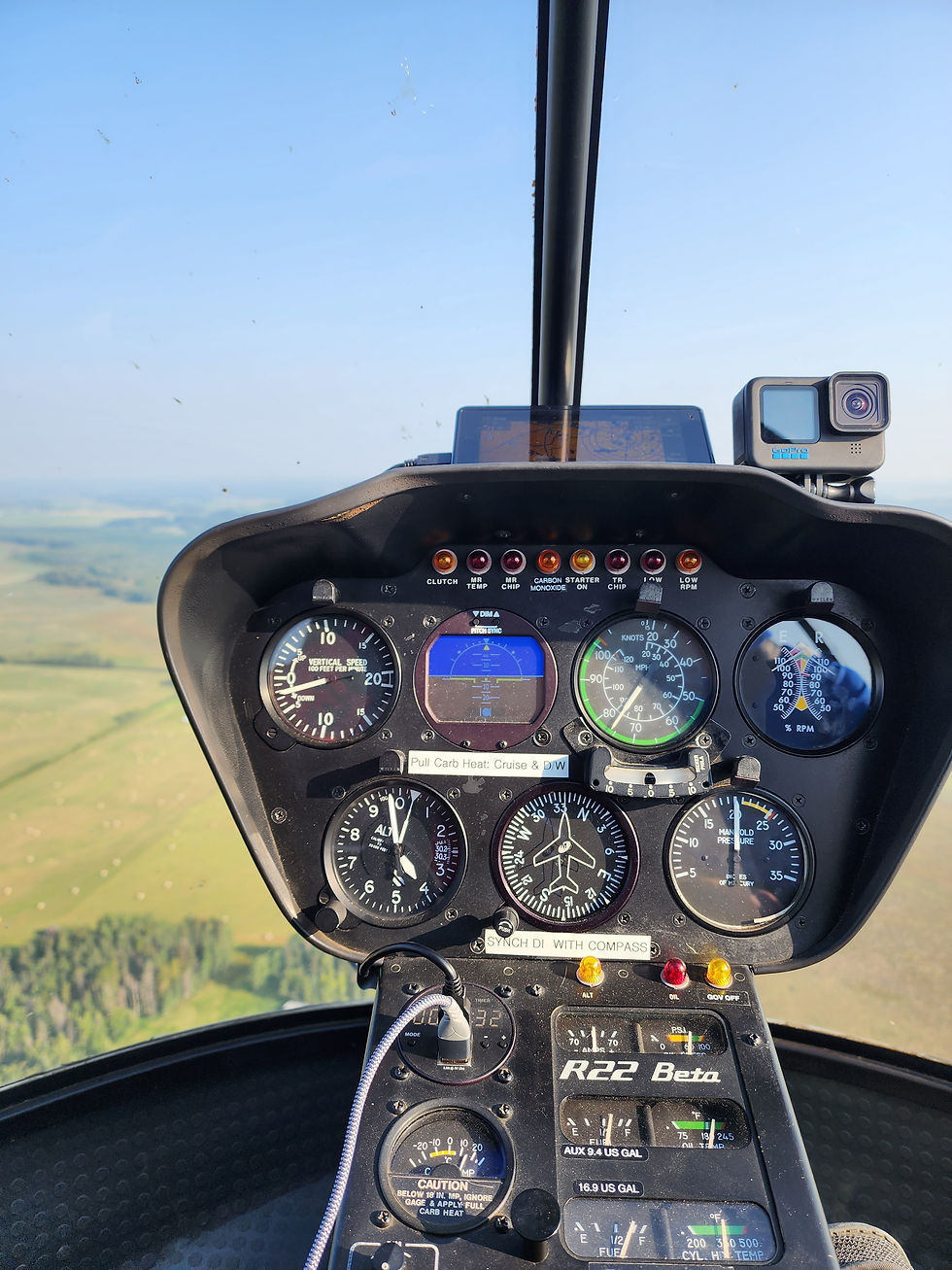
This was much more than another entry in my pilot logbook. It marked my return to helicopter flying after being away from it for approximately three years.
When I first completed my helicopter licence, I trained in the Robinson R22. I loved flying helicopters, but life, work and other responsibilities took over. As more time passed, I began wondering whether I would ever return to rotary-wing flying.
Thankfully, I did.

With the help of Jacki the owner of Foothills Helicopters based out of Okotoks, I climbed back into the cockpit, rebuilt my confidence and completed my R44 training. It was an amazing experience and a reminder that stepping away from aviation does not mean your flying journey is over.
Sometimes it is simply paused.

Is It Difficult to Transition from an Robinson 22 to an Robinson 44?
Many R22 pilots look at the R44 as a major next step. It is a larger helicopter with four seats, more power and different operating characteristics, but the transition may not be as overwhelming as it first appears.
Robinson describes the R44 as a four-seat helicopter designed for a broad range of missions and applications.
When you already have experience flying the R22, many of the basic Robinson helicopter concepts will be familiar. You are not learning how to fly a helicopter from the beginning. Instead, you are learning the systems, limitations, performance and handling characteristics of a different aircraft.
For many current and proficient R22 pilots, the transition may take somewhere around three to ten hours of flight training. The actual time will depend on factors such as:
Your recent helicopter experience
How long you have been away from flying
Your comfort and proficiency in the R22
The flight school’s training program
Instructor assessment
Insurance or operator requirements
How quickly you become comfortable with R44 procedures
Three to ten hours is not a guaranteed regulatory figure. Every pilot is different, and the training should take as long as necessary for the pilot and instructor to be confident that the aircraft can be operated safely.
In my case, returning after three years meant that I was not only learning the R44. I was also rebuilding some of the helicopter skills and confidence that naturally become less sharp when they have not been used regularly.
What Does R44 Training Include?
The exact training program will vary, but an R22-to-R44 transition will normally include ground instruction and flight training.
Ground Training
Before flying the aircraft, you need to understand how it operates.
Ground training may include:
Aircraft systems
Engine and rotor limitations
Normal operating procedures
Emergency procedures
Weight and balance
Aircraft performance
Preflight inspection
Fuel system and fuel planning
Carburetor heat or fuel-injection considerations, depending on the model
Hydraulic flight controls
Governor operation
Low rotor RPM recognition and recovery
Autorotation procedures
Aircraft-specific limitations
The purpose is not simply to memorize numbers long enough to pass a test. You need to understand what the helicopter is doing and why.
Knowing the aircraft’s limitations and emergency procedures becomes especially important in a helicopter, where pilots may need to recognize a developing problem and respond quickly.

Flight Training
Once the ground portion is underway, the flying begins.
Depending on the pilot and instructor, R44 flight training may include:
Start-up and shutdown procedures
Hovering and hover taxiing
Normal and crosswind takeoffs
Approaches and landings
Confined-area procedures
Steep approaches
Quick stops
Advanced takeoffs and landings
Autorotations
Emergency procedures
Governor-off operations
Hydraulics-off procedures
Low rotor RPM recognition and recovery
Aircraft performance and power management
The objective is not just to make the helicopter leave the ground. It is to become comfortable managing the R44 safely through normal and abnormal situations.
How Does the R44 Feel Compared with the R22?
The R44 feels familiar enough that an R22 pilot will recognize its Robinson design, but different enough that it deserves proper training and respect.
It is larger, heavier and more powerful. It also provides more cabin space and can carry additional passengers, making it practical for training, transportation, sightseeing and other helicopter operations.
The R44’s hydraulic controls can make the cyclic feel lighter than pilots may expect after flying an R22. The aircraft’s additional weight also gives it a different feel during hovering, approaches and autorotations.
Those differences do not necessarily make the R44 more difficult. They simply mean that pilots need time with a qualified instructor to understand the aircraft and avoid carrying over assumptions from the R22.
Returning After Three Years Away
The hardest part of returning was not operating a specific switch or remembering a checklist item.
It was getting past the uncertainty in my own mind.
After three years, it would have been easy to tell myself:
I have been away too long.
I will have forgotten too much.
It will take too many hours.
Maybe I should leave helicopter flying in the past.
Those thoughts can stop pilots before they even contact a flight school.
The reality was much more encouraging. The knowledge and muscle memory had not disappeared. Some skills needed polishing, but each flight brought more confidence back.
You do not need to be perfect on your first flight back. That is why you fly with an instructor.
You show up, listen, learn and improve one flight at a time.
Do Not Let the Time Away Stop You
Pilots sometimes believe that taking a break means they must start over. That is usually not the case.
You may need a careful review. You may need additional ground school, several dual flights or more training than another pilot. None of that is failure.
The goal is not to finish in the fewest possible hours.
The goal is to become safe, knowledgeable and confident in the aircraft.
Whether you have been away for six months, three years or even longer, speak with a helicopter flight school and let an instructor assess where you are. You may be much closer to returning than you think.
Transport Canada provides the governing standards for Canadian pilot licences and ratings, while the specific training plan should be established with an appropriately qualified instructor or flight training unit.

Why Get an R44 Rating?
The R44 is widely used throughout the helicopter industry and can open the door to new flying experiences.
Pilots may pursue the rating for:
Personal flying
Aircraft ownership
Hour building
Commercial career development
Sightseeing operations
Photography and observation flights
Transportation
Access to a larger and more capable helicopter
For me, it represented something more personal.
It proved that I could return.
Three years away did not erase the work I had already completed. It did not eliminate my ability to learn, and it did not mean my helicopter journey was finished.
Getting rated on the R44 reminded me why I fell in love with helicopter flying in the first place.
You Can Do It Too
A Robinson R44 rating may be more achievable than you think.
For an experienced and current R22 pilot, the transition could potentially be completed within several hours. Someone returning after a long break may need additional training, and that is completely acceptable.
Do not compare your number of hours with someone else’s.
Find a good instructor. Study the aircraft. Ask questions. Take the training seriously and allow yourself time to enjoy the experience.
I did not know whether I would make it back to helicopter flying after three years away.
Now I am officially rated on the Robinson R44, and I am incredibly grateful that I decided to try.
Your aviation goals do not always happen according to the original schedule. Sometimes there are delays, detours and periods when flying has to take a back seat.
That does not mean the dream is over.
Sometimes all it takes is booking the first flight and getting back into the cockpit.
About the Author
Caleb Winterburn is a commercial fixed-wing and helicopter pilot and the Vice President of Aviation Insurance at Covalen. He has worked in Canadian aviation insurance since the age of 18 and helps aircraft owners, pilots, flight schools and commercial aviation operators understand and arrange aviation insurance coverage.
Caleb recently returned to helicopter flying after approximately three years away and completed his Robinson R44 rating with Foothills Helicopters.
Are you buying, training on or insuring a Robinson helicopter?
Request a free, no-obligation aviation insurance quote through Covalen:
Important note: Training time, licensing requirements and aircraft endorsement procedures depend on the pilot, aircraft, instructor, operator and applicable Canadian requirements. Always confirm the current requirements with your flight school, instructor and Transport Canada.


Comments